Penny Auction Web Application
A Look Back: Building the Perabid Penny Auction
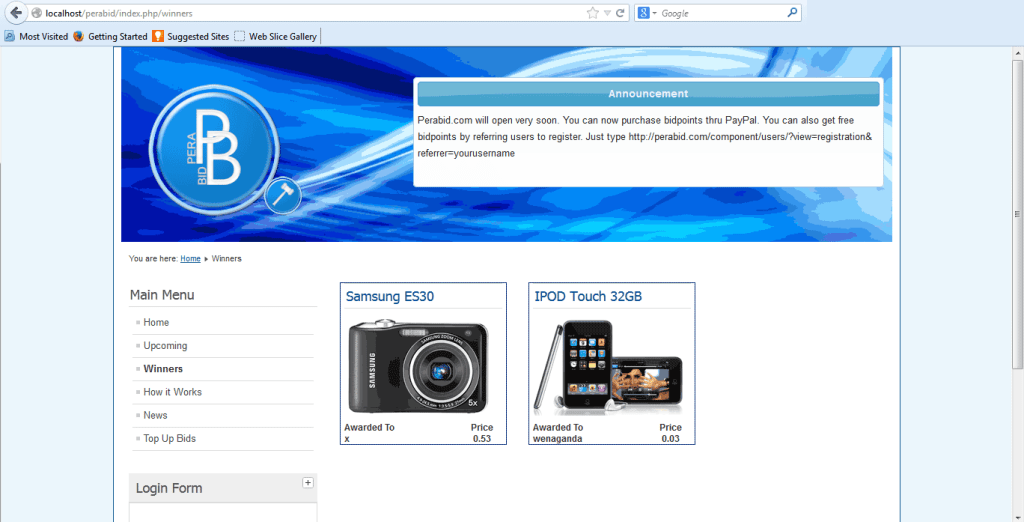
In my journey as a developer, some projects stand out not just for the final product, but for the sheer challenge of their construction. One of the most technically demanding applications I ever built alone was Perabid, a penny auction website. Unlike standard e-commerce sites, a penny auction requires a delicate balance of real-time processing, database integrity, and server-side logic. It was a formidable undertaking, and I built it from the ground up using the classic, reliable LAMP stack.
First, What Exactly is a Penny Auction?
Before diving into the technology, it’s important to understand the concept, as it dictates all the architectural decisions. A penny auction isn’t a traditional auction. The model is based on a few key mechanics:
- Pay-Per-Bid: Users must first purchase packs of bids. Each bid they place on an item costs them one bid from their balance, regardless of whether they win.
- Tiny Price Increase: Each bid only increases the item’s price by a very small amount, typically a single cent (or in our local context, one centavo).
- Resetting Timer: The real excitement comes from a countdown timer (e.g., 15 seconds). Every time a bid is placed, the timer resets. The last person to bid when the timer finally runs out wins the item for the final, deceptively low price.
This was the model for Perabid. The name itself was a fusion of “Pera,” the Filipino word for money, and “bid,” reflecting the core concept of spending money to participate.
The Architectural Challenge & The LAMP Solution
A penny auction’s success hinges on its ability to handle three critical tasks flawlessly: manage user bid balances, process bids instantly, and keep a perfectly synchronized timer for all users. Tackling this as a solo developer required a technology stack that was robust, transparent, and something I could control completely. This made LAMP (Linux, Apache, MySQL, PHP) the perfect choice.
- L for Linux: The entire project was hosted on a Linux server. For an application where server uptime and stability are directly tied to financial transactions and auction outcomes, Linux was the only choice for its rock-solid reliability.
- A for Apache: The Apache HTTP Server acted as the frontline, managing the constant stream of requests from users watching the timers. The real-time feel of the auction was simulated by the user’s browser repeatedly asking the server for updates, and Apache handled this relentless traffic with ease.
- M for MySQL: This was where the most complex logic resided. I designed the MySQL database not just to store users and products, but to be a transactional powerhouse. Every single bid was an atomic transaction that had to do three things without fail:
- Securely deduct a bid from the user’s balance.Record the bid itself with a precise timestamp.Update the auction item’s price and reset its timer.
- P for PHP: The PHP backend was the brain of the operation. It executed the critical logic. When a user clicked “Bid,” the browser would send a request to a PHP script. This script would validate the user’s session, connect to MySQL to run the transaction shown above, and then return a success or failure message. The “real-time” countdown on the website was achieved using JavaScript on the frontend making frequent AJAX (Asynchronous JavaScript and XML) calls to lightweight PHP scripts that simply reported the current state of the auction.
A Formative Solo Experience
Building a time-critical, transaction-heavy application like a penny auction site alone was an incredible challenge that pushed my skills in database architecture and backend programming. The LAMP stack provided the power and control I needed to implement the complex logic precisely.
Though Perabid is now a project in my development history, the lessons I learned about database transactions, server-side logic, and building resilient systems are timeless. It remains a cornerstone of my portfolio and a project I look back on with pride.